In Part I we traced the lineage — Ford to Kingsford to Firestone to Byam to George Stephen to the RAAK. But that was the product lineage. This is the economy. And to understand it properly, you have to start with an honest description of how the Vagabonds actually traveled.
Fifty vehicles. A professional chef in a bow tie. A kitchen car with a built-in icebox and a gasoline stove. A folding circular table with a lazy susan that seated twenty. Electric lights in the tents. Personal attendants. A film crew. The Vagabonds were not camping. They were glamping — a century before the word existed. Ford demonstrated the aspirational ceiling of vehicle-based outdoor living and put it in theaters nationwide.
And simultaneously — with the Model T he had already put in the hands of the workers who built it — he gave ordinary Americans the vehicle to chase that same dream on their own terms. Car camping was born. The Tin Can Tourists followed. And the downstream economy those two ideas created, at both ends of the spectrum, now generates $887 billion annually. Not because Ford planned it, but because he demonstrated something true: that time outside, reached by a vehicle, made people better. The economy followed the conviction. It always does.
and the 80-Year Unanswered Question
In 1916, a fourteen-year-old boy from San Francisco made his first trip to Yosemite. His parents gave him a Kodak Brownie box camera. He photographed everything he could see — the falls, the granite, the light — and came back a different person. His name was Ansel Adams. He spent the next decade as a custodian at the Sierra Club lodge in Yosemite, and began making the landscape photographs that would eventually redefine how Americans understood their own wilderness.
He could reach Yosemite because of the automobile. He could reach forty national parks across his career — Grand Teton, Glacier, Monument Valley, Yellowstone, the Grand Canyon — because of the automobile. The Vagabonds had traveled those same western landscapes a decade earlier with chefs and electric lights and a film crew, demonstrating to a nation of theater-goers that the wilderness was worth reaching. Adams reached it with a station wagon and a wooden camera platform on the roof — the democratized version of the same impulse. Ford's mobile America was Adams's studio, and Adams's studio produced the visual argument that saved it. His photographs of Kings Canyon, lobbied directly to Congress in the 1930s, helped establish it as a national park. His work for the Department of the Interior produced murals that hung in government buildings. He received the Presidential Medal of Freedom in 1980 in part for his role in expanding the National Park system. Every one of those parks is more accessible today because Ford put Americans in cars. Adams documented what they found when they got there — and made the case that it was worth protecting.
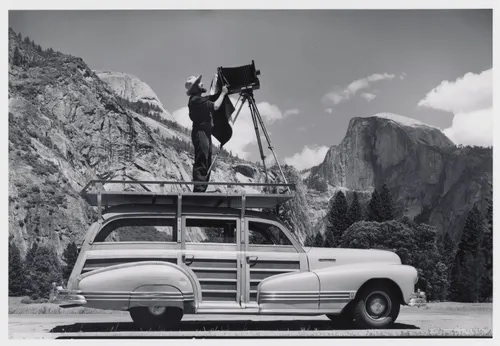
But the detail that connects Adams to this lineage most directly is not his photography. It is his vehicle.
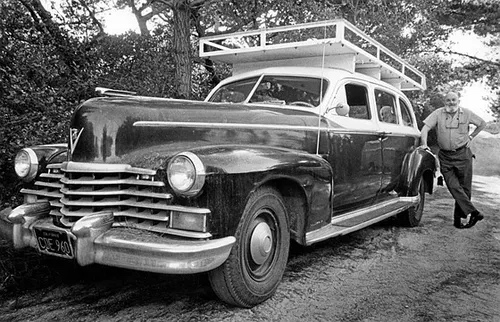
In the early 1940s, Adams outfitted his Pontiac Woody station wagon with a custom camera platform mounted to the rain gutters. He stood on the roof of his car, set up his 8×10 large format camera on a tripod, and shot from that elevated platform across the rest of his career — on multiple vehicles, each one customized with the same system. A Cadillac woody. An International Travelall. A 1970 Ford LTD sedan. Most of his iconic landscapes from 1943 onward were made not from mountain summits reached by rugged hiking, but from the roof of his car. The vehicle was not the way he got to the work. The vehicle was the platform from which the work was done.
He built the first version himself — a wooden board across standard roof crossbars. Simple. Functional. Immediately obvious to anyone who saw it. Why didn't every landscape photographer build one? Many of Adams's students and assistants did exactly that — Alan Ross, John Sexton, and others who trained with Adams built their own roof platforms. But the idea never escaped the community of serious large format photographers. It was never manufactured. Never marketed. Never made available to the painter, the writer, the filmmaker, the naturalist, the sketcher, the musician who wanted to work from the landscape rather than merely visit it.
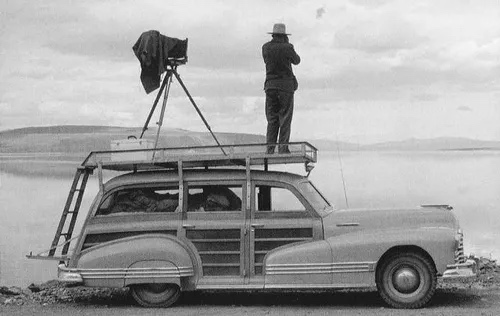
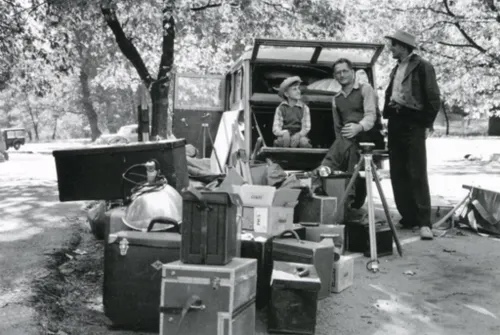
Look at that second photograph carefully. That is not a camera bag. That is a complete mobile photographic operation — cases, tripods, darkroom equipment, film holders, lenses — all carried by the vehicle, all deployed from the vehicle, all organized around the vehicle as the base of operations. Adams didn't just use the car to get there. He used it the way a ship's captain uses a vessel: as the command platform from which everything else is organized and deployed.
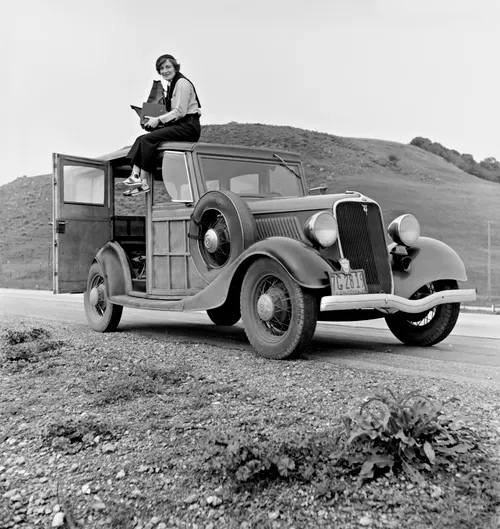
The instinct was not unique to Adams. In the fourth image in this collection, a young woman sits on the roof of a 1930s Ford vehicle on a roadside, a sketchbook in her hands, the hills behind her. She is not a famous photographer. She is not building an empire. She is simply a person who looked at the roof of a car and saw a better place to work than the ground. The vehicle as a creative platform is not an Adams innovation. It is a human instinct that the automobile made possible. Adams simply systematized it more deliberately than anyone else — and still never turned it into a product.
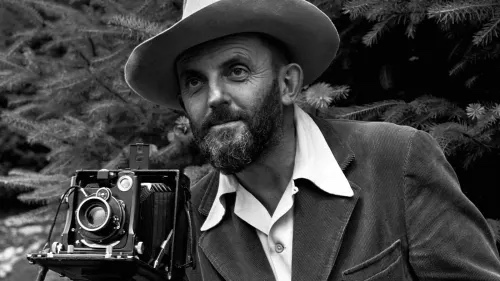
Adams was a photographer, not an entrepreneur. George Stephen looked at his buoy mold and saw a product he could sell. Adams looked at his roof platform and saw a tool he could use. The same instinct — see something differently — but pointed in two completely different directions.
— The Continuity of Experience · Tymmber Franklin LibraryGeorge Stephen looked at a buoy mold and built 50 kettle grills and sold them for $49.95. Had Adams looked at his roof platform with Stephen's eyes, he might have built 50 vehicle camera platforms and sold them to the photographers he was training. He didn't. He gave the idea away through his workshops, his books, his teaching — and it stayed inside the community of large format photographers for eighty years.
The RAAK Artist Station is the first commercial answer to the question Adams demonstrated in 1943. Not just for photographers — for every person who has ever looked at a landscape and wanted to work from it rather than merely pass through it. The painter. The musician. The writer. The filmmaker. The naturalist with a sketchbook on the roof of a 1930s Ford. Adams solved it for himself. Tymmber solved it for everyone.
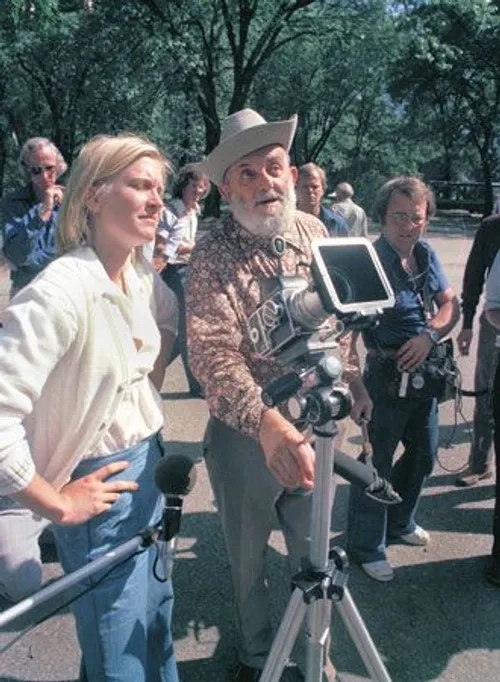
One final detail on Adams that belongs in any honest account of this lineage. The woman beside him in several of the later photographs is Susan Ford — daughter of President Gerald Ford. Adams is photographing in Yosemite, the park his photographs helped protect, beside the daughter of a President, in a valley accessible to millions of Americans because of the automobile Henry Ford democratized. The circle is complete without any of the participants having designed it that way. That is how the best lineages work.
Every Great Brand Begins the Same Way
The outdoor economy Ford seeded didn't produce only one or two downstream innovations. It produced an entire generation of entrepreneurs who built their companies on the same foundation: a person with a problem, materials in front of them, and enough imagination to see it differently. Two of the most important were W.C. Coleman and Eddie Bauer. Both started from nothing. Both began in the same era. Both built category-defining companies from personal conviction. And both — like Kingsford, like Firestone, like George Stephen — embedded their origin stories in their names and their founding decisions in ways that outlasted everything that followed.
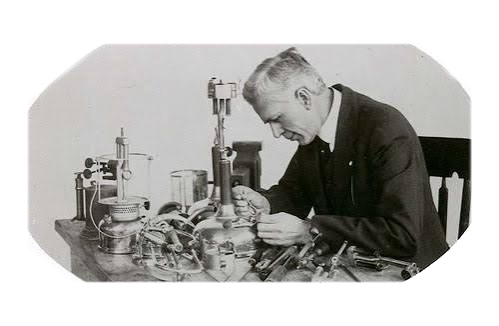
Coleman
A traveling salesman in Oklahoma who walked past a drugstore window and noticed a gasoline lamp burning with an unusually bright, white flame. He had poor eyesight. The brightness struck him. He immediately understood that this light — so different from the smoky yellow of standard kerosene — could help people work, read, and see better. He switched from selling typewriters to selling lamps. He moved to Wichita. He built a company. Eventually he served as mayor of Wichita. Coleman is now one of the most recognized outdoor brands on earth.
Coleman's camp stove arrived in 1923 — precisely as the auto camping movement Ford had seeded was reaching its first mass adoption. Coleman's own historian marks 1923 as the beginning of Coleman the outdoor company, noting explicitly that it came at the moment when "the Model T Ford became affordable to millions of American families. They began to travel and vacation more. Motor camping became quite popular." Coleman didn't cause motor camping. Motor camping caused Coleman. The camp stove was Ford's outdoor culture made portable.
The lantern and stove grew through the 1920s. Coleman survived the Depression by expanding into oil heaters and gas furnaces. And then the war came — and everything changed. Coleman's camp stove, born from the auto camping movement of the 1920s, became one of the most critical pieces of military equipment in the Second World War. We will return to that in Act III.
Bauer
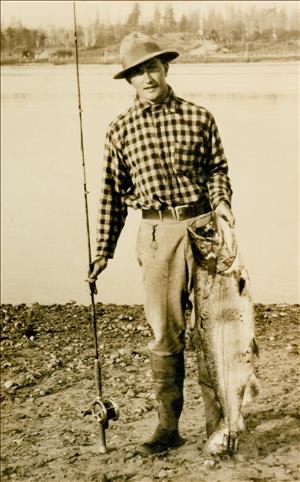
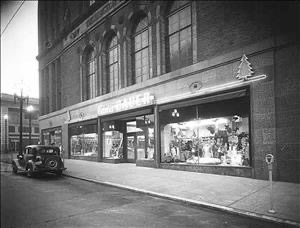
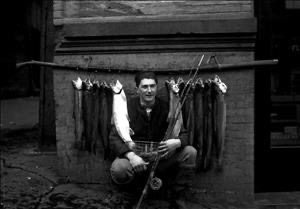
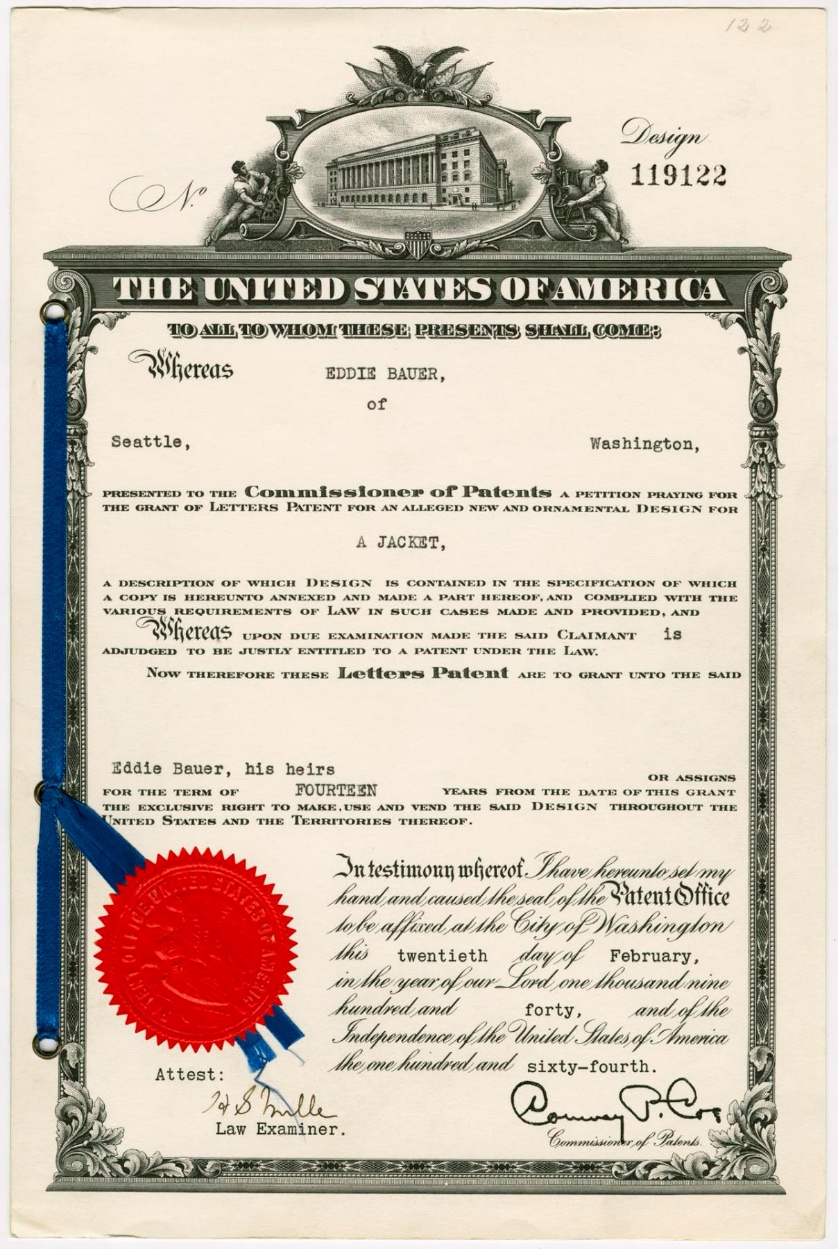
Born on Orcas Island in Puget Sound, October 19, 1899. Grew up hunting and fishing in the forests and mountains of the Pacific Northwest. Opened a small sporting goods store in downtown Seattle in 1920. In the early years, he hung a "Gone Fishin'" sign in the window every Labor Day and didn't return until February — spending five months testing gear in the backcountry. When he couldn't find quality products from existing manufacturers, he built his own. In January 1935, a fur trapper named Red Carlson saved his life after he became hypothermic on a fishing trip. Eddie went home and invented the first quilted down jacket in America. He filed the patent on December 26, 1939 — Christmas Day — and it was granted February 20, 1940.
The detail most histories miss is the shuttlecock. Before the down jacket, before the flight suit, before the patent — Bauer was making badminton birdies. He replaced expensive imported shuttlecocks with his own design using goose quills from a fishing tackle supplier. By the end of the 1930s his shuttlecocks were used in national tournaments. He became intimately familiar with goose feathers and down making sporting equipment. When Red Carlson pulled him back from hypothermia in January 1935, Bauer already knew exactly what material could hold enough warmth to prevent it happening again. The down jacket wasn't a leap of imagination. It was the inevitable convergence of years of material knowledge and one near-fatal fishing trip.
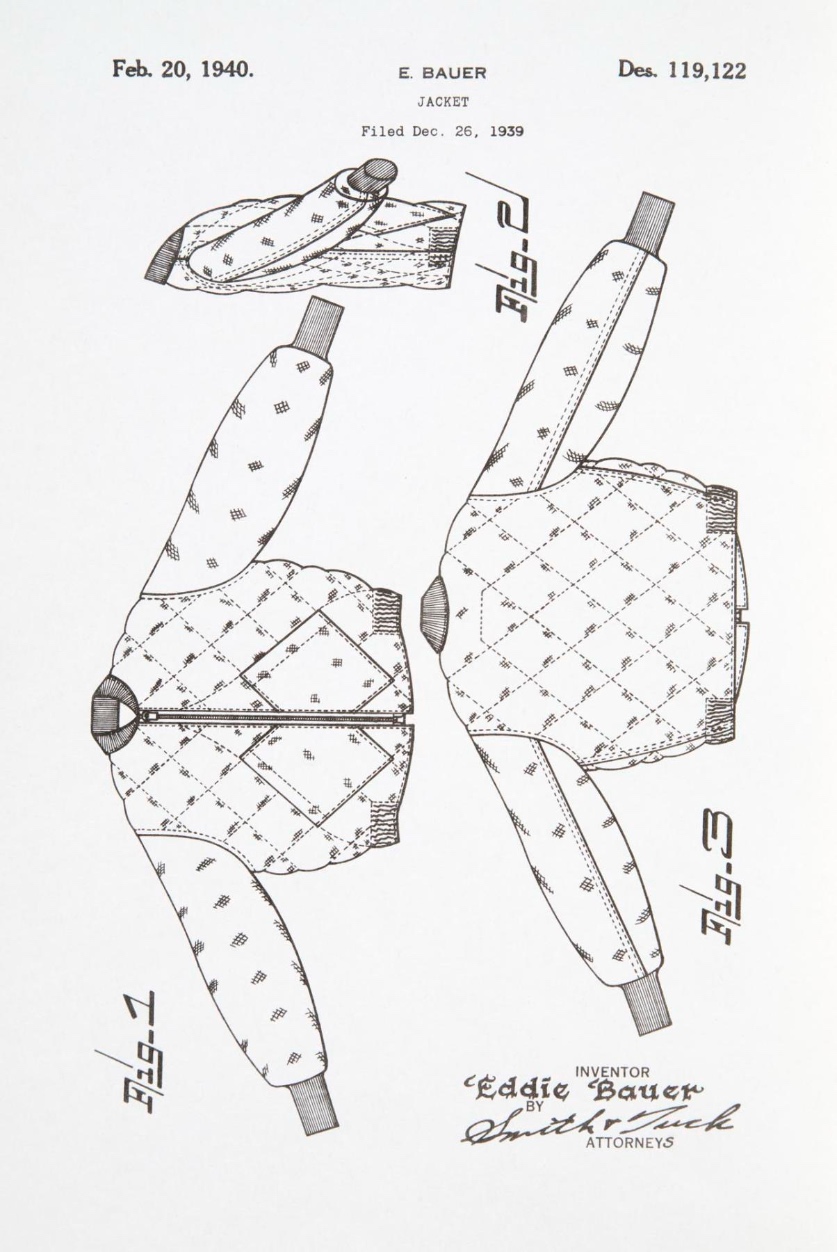
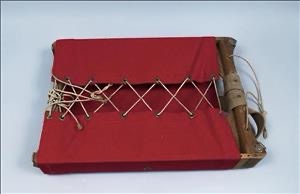
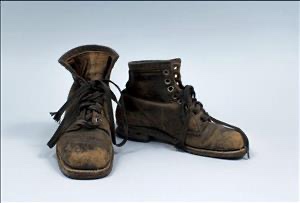
The timing of Eddie Bauer's founding — 1920, peak Vagabond era — is not coincidence. It is cause and effect. Ford had spent six years putting the outdoor lifestyle in American newsreels and national newspapers. A Pacific Northwest outdoorsman who hunted and fished opened a sporting goods store for the people who were now, for the first time in American history, driving to the wilderness in significant numbers. The market Ford created was the market Bauer served.
And there is a closing irony that belongs in the record: Eddie Bauer eventually licensed his name to Ford. The Eddie Bauer Edition Bronco. The Eddie Bauer Explorer. The Eddie Bauer Expedition. The outdoor brand that Ford's automobile culture created ended up branding Ford's vehicles. The downstream tributary flowing all the way back to the source. King. Ford. Fire. Stone. Eddie. Bauer.
The Gear the Campers Built
Won the War.
Here is the thing nobody says plainly: the American outdoor industry that Ford's mobile culture created did not just make camping more comfortable. It equipped the United States military for the Second World War. The camp stove that auto campers used beside their Model Ts in the 1920s. The down jacket that outdoorsmen wore hunting in the Pacific Northwest. The sleeping bag. The portable lantern. All of it crossed over from leisure to warfare in the early 1940s — and in several cases, the outdoor industry's products were so technically superior to anything the military had developed that they became standard issue.
Coleman's GI Pocket Stove — developed in fewer than 60 days after the War Department contacted the company with specifications that seemed impossible: lightweight, no larger than a quart thermos, capable of burning any fuel, operational in temperatures from -60° to 125°F. Coleman demonstrated a working prototype within 60 days. In November 1942, 5,000 stoves shipped to North Africa with U.S. forces. Over a million were eventually produced. They went into tents, foxholes, and bombers across every theater of the war. A Los Angeles Times article noted that many a huddle of soldiers got the warmth to survive and fight another day from a Coleman stove. The camp stove that motor camping created. The camp stove Ford's culture made necessary.
Eddie Bauer's B-9 Parka — in 1942, the U.S. Army Air Forces contacted Bauer asking him to design a cold-weather buoyancy flight suit for pilots. He went to Wright Field in Dayton, Ohio, and designed the down-insulated B-9 Parka and A-8 Flight Pants. Over the course of the war, Bauer manufactured approximately 50,000 of these suits and over 200,000 sleeping bags for the military. The down jacket that a Seattle outdoorsman invented after nearly freezing to death on a fishing trip became the garment that kept American pilots alive over Europe and the Pacific. The outdoor economy went to war. And it won.
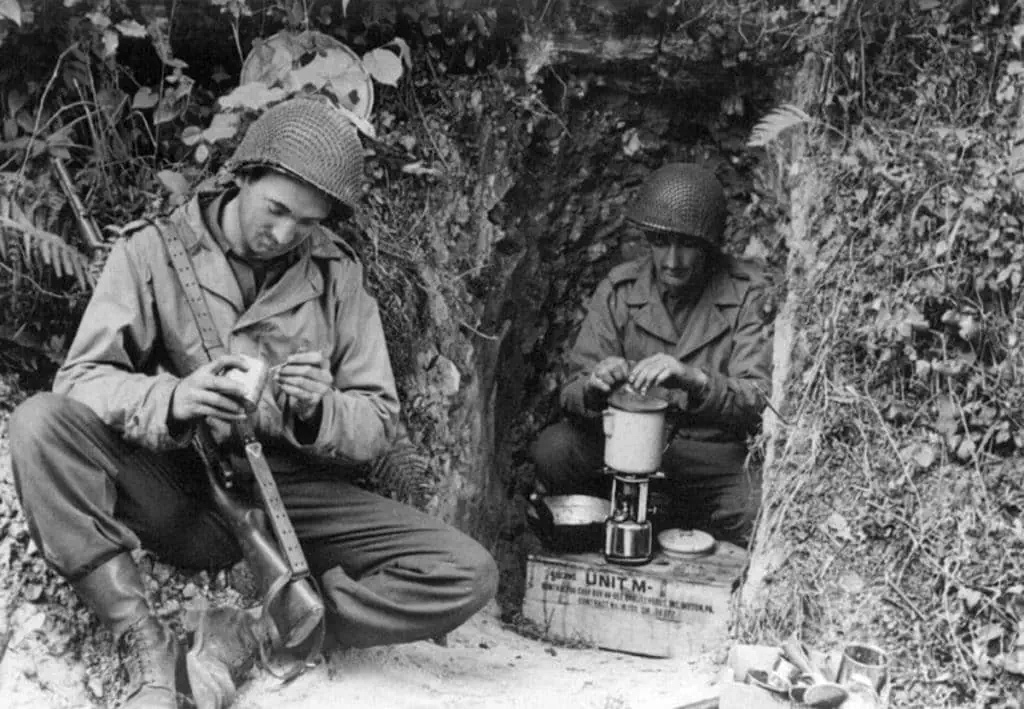
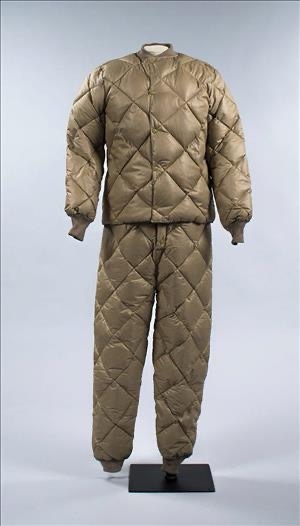
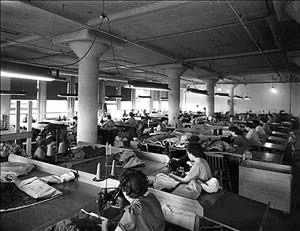
The war did something else. It trained a generation of American men in the use of outdoor equipment — stoves, sleeping bags, tents, boots, packable food — and then sent them home. They came back knowing how to camp, knowing what good gear felt like, knowing the difference between equipment that worked and equipment that didn't. They came home and went camping with their families. The postwar outdoor recreation boom — the one that produced the Coleman catalog image of a family station wagon loaded with every product the company made — was seeded in the foxholes of Europe and the Pacific, by the same gear that Ford's culture had produced in the decade before the war.
The image below is one of the most important photographs in this entire two-part series. Not because it is dramatic or beautiful or historically significant in the way the Adams photographs are. But because it is the fullest possible expression of what Ford's campfire produced in fifty years.
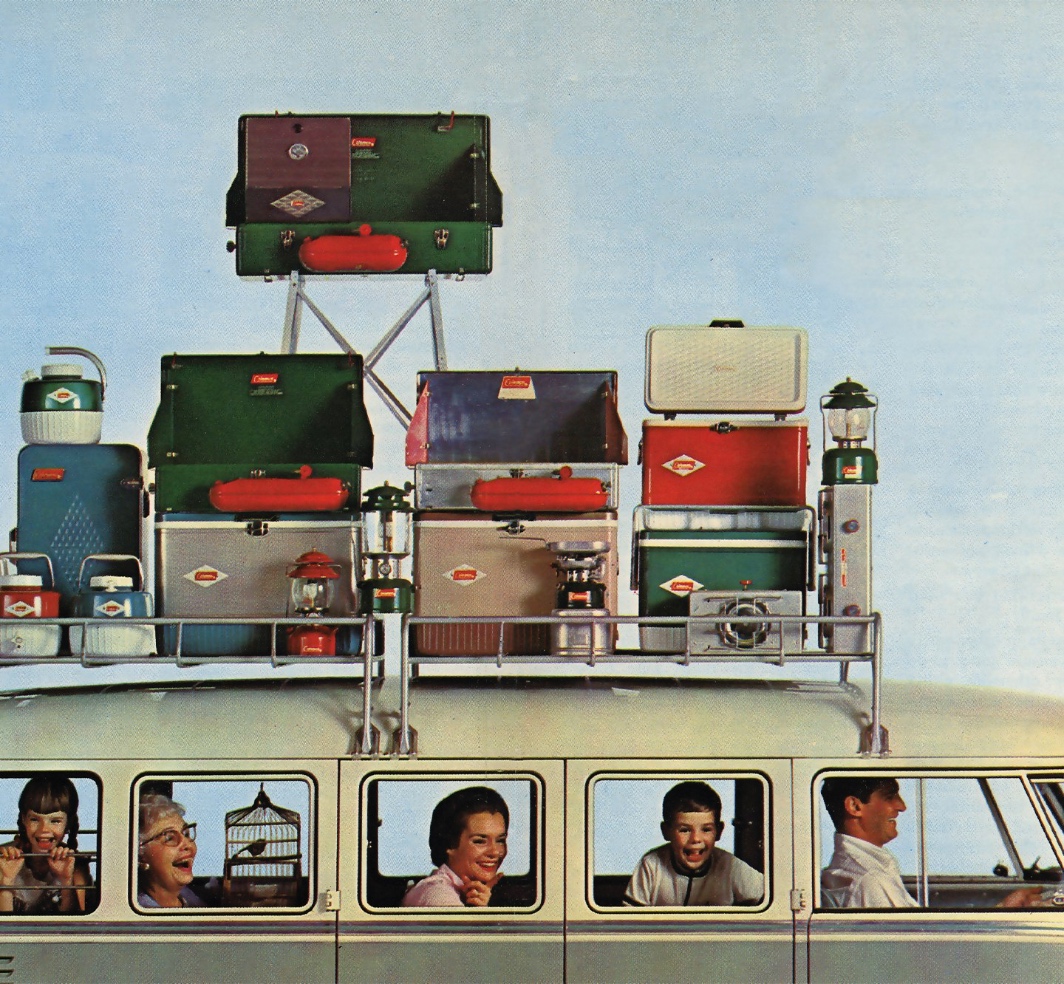
A family station wagon. A roof rack so loaded with Coleman products — stoves, coolers, lanterns, jugs, cases — that it towers above the roofline. A family visible through the windows, every one of them grinning. This is Ford's outdoor America at its fullest expression: the vehicle, the equipment, the family, the road. All of it organized around the conviction that time outside made people better — a conviction Ford demonstrated with a film crew in 1914 and that a nation of families was now acting on every summer weekend with Coleman gear on their roof racks.
The product category that image represents — automotive-mounted outdoor equipment — is the direct continuation of the Adams roof platform, the Tin Can Tourist's canvas awning, the Airstream hitch, and every other version of the same question: what else can this vehicle carry? Coleman answered it with coolers and lanterns. Adams answered it with camera platforms. The auto camping industry answered it with roof tents and cargo boxes. Nobody ever answered it with a complete integrated system — until the RAAK.
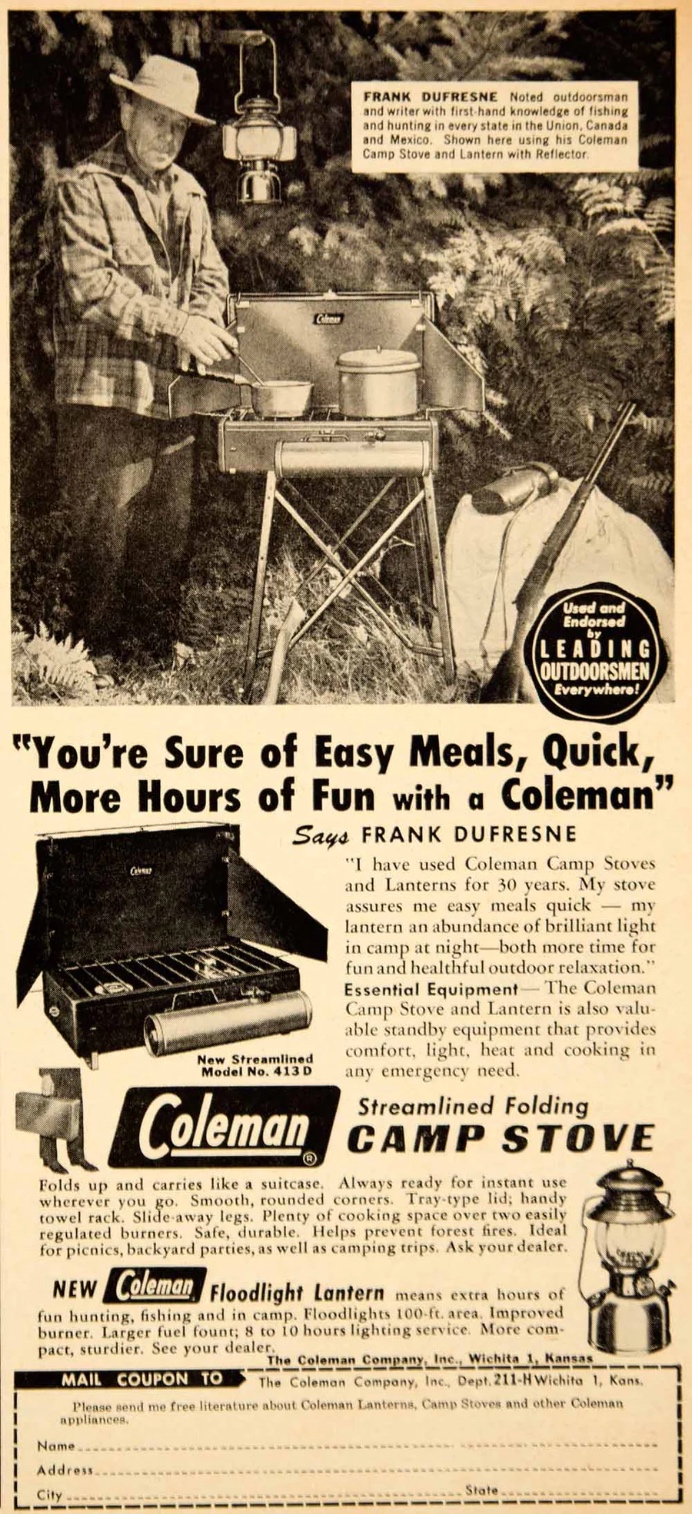
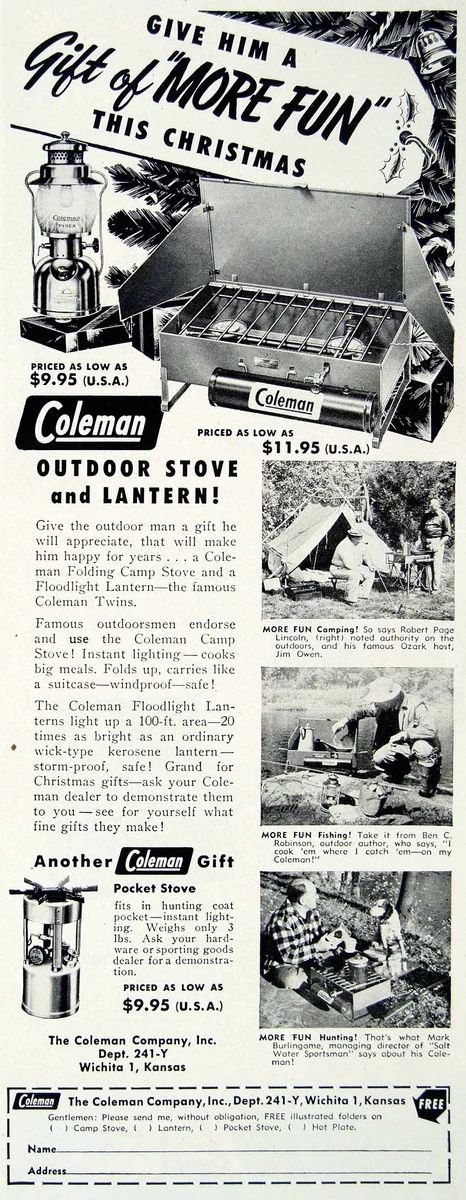
Look at the Coleman advertising. Frank Dufresne — "noted outdoorsman and writer" — endorsing the camp stove. Famous outdoorsmen camp beside their Coleman stoves in every magazine Ford's culture produced a readership for. The advertising model is identical to Ford's Vagabond newsreels: a credible, respected person living the outdoor life, the product visible in the frame. Ford invented this model in 1914 with a film crew in the wilderness. Coleman applied it to a $9.95 camp stove in 1955. The influence is direct and documented.
The Christmas gift ad is perhaps the most culturally significant of the three. "Give him a gift of MORE FUN this Christmas." The outdoor stove and lantern as a holiday gift. Camping and fishing and hunting shown as joyful leisure. The outdoor economy has become so normalized — so embedded in the American family's sense of what the good life looks like — that its products are exchanged under Christmas trees. Ford seeded this culture in 1914. By 1955 it was the fabric of American life.
The $887 billion figure — the Outdoor Industry Association's measurement of outdoor recreation's annual contribution to U.S. GDP — is the sum of everything below. Every category traces a direct line to Ford putting ordinary Americans in cars and showing them the wilderness through a film crew and a theater screen.
Luxury Outdoor
Fire
Gear
Travel
Platform
& Parks
& Sport
& Commerce
Culture
& Tools
One campfire.
$887 billion.
And still burning.
Ford didn't plan any of this. He didn't sit down in 1914 and map the downstream consequences of putting ordinary Americans in cars and showing them the wilderness. He followed a conviction — that the outdoors made people better — and demonstrated it with a film crew and a decade of summer trips. The economy followed the conviction. It always does.
Coleman followed the light in a drugstore window. Eddie Bauer followed a near-fatal fishing trip. Ansel Adams followed a fourteen-year-old boy's first glimpse of Yosemite through a Kodak Brownie. W.C. Coleman built a camp stove because motor campers needed one. Eddie Bauer built a down jacket because he nearly froze. Adams built a roof platform because he needed elevation. Every one of them was responding to an experience — the experience that Ford had seeded in the culture and equipped with a vehicle and made available to everyone.
None of them built the system. Coleman solved the fire. Bauer solved the warmth. Adams solved the creative elevation. Airstream solved the shelter. George Stephen solved the grill. The Tin Can Tourists solved the hack. But the journey from the hitch to the home camp — the integrated, deployable, vehicle-based outdoor life platform — remained unsolved. A collection of brilliant individual answers with no architecture connecting them.
The RAAK is not the end of the lineage. It is the integration of it. Every answer the outdoor economy built across a hundred years, organized into a single platform that any vehicle with a hitch can carry. Hitch to Home. The system Ford pointed toward in 1914, that Adams elevated in 1943, that Coleman equipped for a generation of returning soldiers in 1945, and that nobody connected into one thing until now.
Ansel Adams photographs — From the Ansel Adams Archive, Center for Creative Photography, University of Arizona. Adams on Woody station wagon, Half Dome, Yosemite, circa 1941–42; Adams on roof platform, lake behind, circa 1943–50; Adams with crew unloading vehicle, Yosemite; Adams with Cadillac and roof platform; Adams portrait with large format camera. Reproduced for editorial and educational purposes.
Adams with Susan Ford — Ansel Adams Archive. Susan Ford is the daughter of President Gerald R. Ford.
Artist on 1930s Ford vehicle with sketchbook — Library of Congress Prints and Photographs Division. Public domain.
Eddie Bauer images — Courtesy Museum of History and Industry (MOHAI), Seattle, and Eddie Bauer LLC: Eddie Bauer salmon fishing portrait; young Eddie Bauer with fishing catch; Second Avenue store Seattle night photograph circa late 1930s; factory floor wartime production; field boots artifact; badminton shuttlecock artifact; B-9 flight suit artifact; U.S. Design Patent No. 119,122 certificate and drawing, February 20, 1940. Eddie Bauer® is a registered trademark of Eddie Bauer LLC.
Soldiers in foxhole with Coleman camp stove, WWII — National Archives and Records Administration. Public domain.
Coleman family station wagon advertisement; Coleman camp stove Frank Dufresne advertisement; Coleman Christmas gift advertisement — Courtesy Coleman Company / Newell Brands. Coleman® is a registered trademark of Newell Brands.
W.C. Coleman at workbench — Public domain / Coleman Company archives. Courtesy Coleman / Newell Brands.
Abandoned woody station wagon — Courtesy Karen Perrin Photography.
Outdoor Industry Association · "Outdoor Recreation Economy" · outdoorindustry.org · $887 billion annual contribution to U.S. GDP; 7.6 million American jobs
Wikipedia / Ansel Adams · "In 1943, Adams had a camera platform mounted on his station wagon, to afford him a better vantage point over the immediate foreground and a better angle for expansive backgrounds. Most of his landscapes from that time forward were made from the roof of his car." Confirmed across multiple sources including Large Format Photography Forum (largeformatphotography.info) and Ansel Adams official publishing channels (anseladamsbooks.com)
Ansel Adams official heritage · anseladamsbooks.com · "In the early 1940s Ansel outfitted his Pontiac Woody wagon with a custom camera platform...This innovation became a staple of Ansel's photography practice that he then carried over to subsequent vehicles."
Coleman Company history · "History of Coleman Backpacking Stoves" · Coleman press release, August 24, 2006 · "Their first camp stove — the Model One — was introduced in 1923. Coleman's historian marks that date as the beginning of Coleman, the outdoor company, noting it came at a time when 'the Model T Ford became affordable to millions of American families.'"
Coleman Company history · campingandcaravandirect.co.uk · GI Pocket Stove development timeline; specifications; North Africa deployment November 1942; over one million units produced
HistoryLink.org · "Bauer, Eddie (1899–1986)" · historylink.org · Eddie Bauer founding 1920, Seattle; hypothermia incident; down jacket patent 1940; B-9 Parka development 1942; 50,000 flight suits manufactured; 200,000+ sleeping bags for military
Wikipedia / Eddie Bauer · "The company also licenses the Eddie Bauer brand name...for upper level versions of the Ford Motor Company's Bronco, Explorer, Expedition and Excursion SUVs." Confirmation of Eddie Bauer / Ford licensing relationship
Sotheby's · "Ansel Adams and the U.S. National Park System" · sothebys.com · Adams's role in Kings Canyon National Park establishment; work with Department of the Interior; Presidential Medal of Freedom 1980 citation