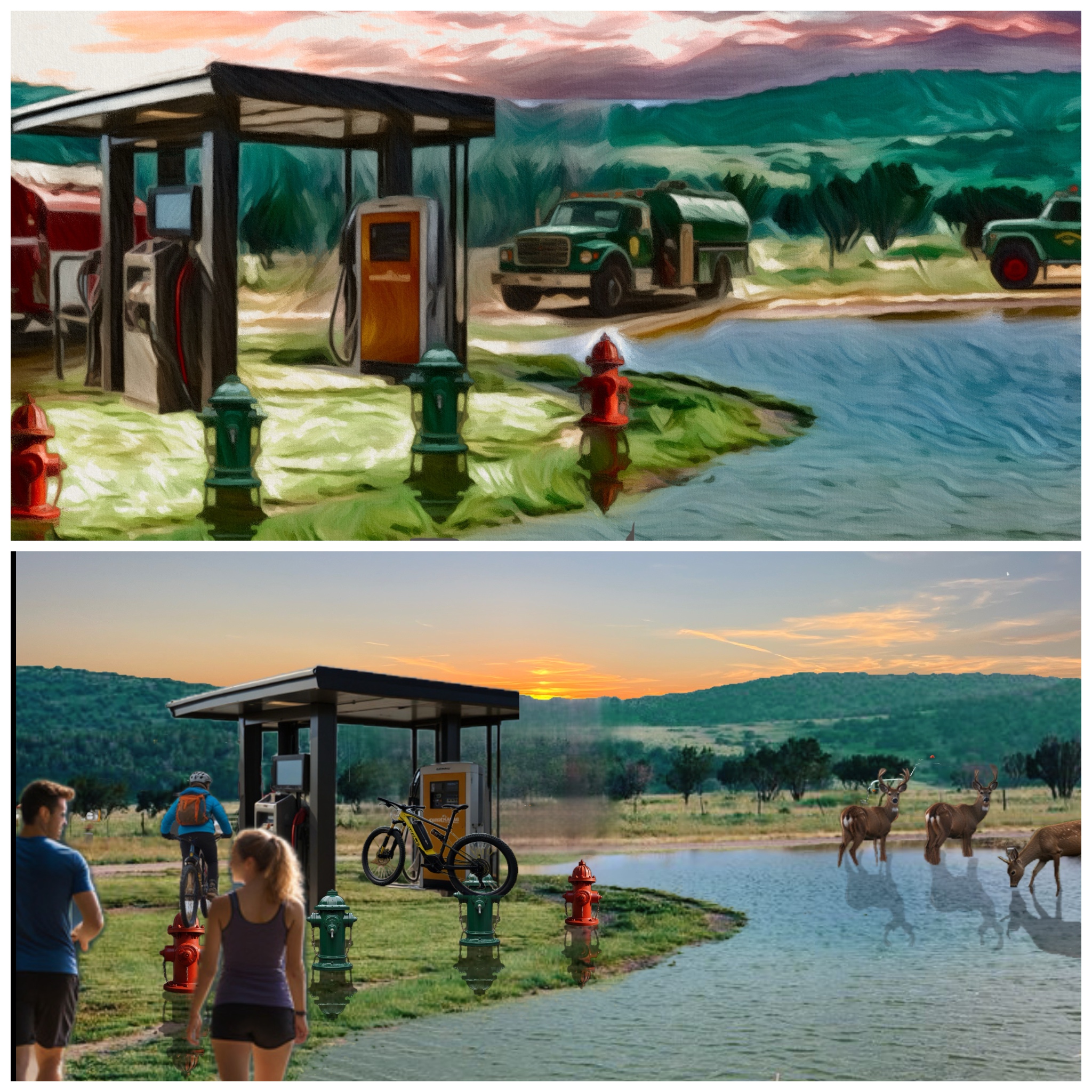
This one started with a picture, not an argument. A pond with cattle drinking from one side and ducks on the other. A solar canopy at the edge, charging a bike. Two fire hydrants standing in the grass next to it, for no obvious reason — until you remember what New Mexico's summers have looked like lately.
So here's the case, in numbers, not just a picture. New Mexico has had five wildfires in the past fifteen years that each burned more than 130,000 acres. One of them — the second-largest in state history — burned through Sierra County itself. None of that acreage is a coincidence, and none of it is a problem any single rancher, agency, or company can fix alone.
What follows pulls from more ground than a typical wildfire memo. It runs through the actual pain points slowing fire response on rural land today. It runs through a piece of water law most New Mexicans have never had reason to think about, and a Supreme Court settlement that closed thirteen years of litigation over the Rio Grande only weeks before this memo was written. It runs through a data center rising in the same county as the Hatch chile fields, drawing groundwater from the same stretch of river. And it ends with a question I don't have the answer to yet: whether the people who've spent decades on opposite sides of this state's land and water fights can find enough common ground, on this one issue, to sit at the same table.
Five fires in New Mexico's history have burned more than 130,000 acres apiece. The Calf Canyon/Hermits Peak Fire (2022) is the largest, at 341,735 acres, not contained for four months after starting as an escaped prescribed burn that merged with a holdover pile burn. The Black Fire (2022), second largest at 325,136 acres, burned through Sierra, Catron, and Grant counties — our own county — and consumed more than 90 percent of the Aldo Leopold Wilderness. The Las Conchas Fire (2011), once the largest fire in state history at 156,593 acres, was started by a tree falling on a power line. The Whitewater-Baldy Fire (2012) and Silver Fire (2013) round out the list, both lightning-caused, both in the Gila, both over 130,000 acres.
Five of New Mexico's worst fires happened in the last fifteen years. One of them burned through the county I live in. That's not a statistic to me. That's the ground outside my door.
None of this is a water shortage problem, not in the way people usually mean it. Ranchers already have ponds. Farmers already have wells. The water mostly exists. What's missing is the interface between that water and a fire crew that needs it fast.
Three things slow the response every time: water sits far from the fire, so helicopters and scoopers fly long round trips between drops; most rural land has no hydrants, so engines draft by hand or wait on a tender truck; and the grid fails exactly when it's needed most, because utilities cut power during high fire-risk conditions to keep their own lines from sparking a fire — the same moment a grid-tied well pump loses pressure.
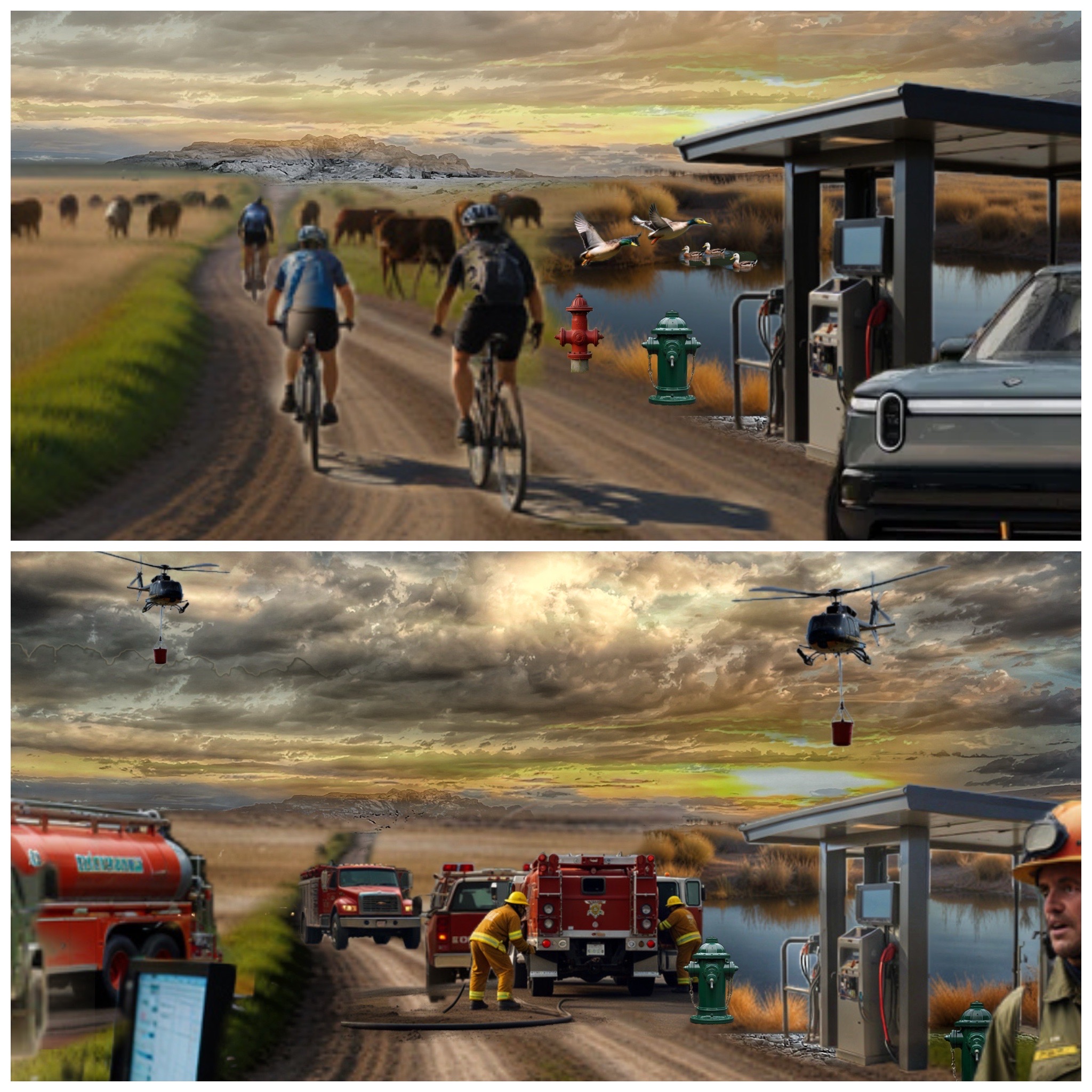
Put a small, off-grid interface on top of whatever water source already exists. A rancher's pond is surface water, already permitted for stock use — add a solar canopy, a pump, and a hydrant pair, and it waters cattle and wildlife every day, and refills a helicopter or holds pressure for an engine on a fire day. A farmer's well is groundwater, a different legal category, but the same interface fits on top of it. Nobody has to build new water. Somebody has to build the thing that turns water that's already there into water you can actually use in an emergency.
Nothing about the water changes between these two columns. Only what it's asked to do does.
Oregon's water code already exempts firefighting from the permit process the same way it exempts stock watering — a water right is never required there for emergency firefighting. New Mexico's State Engineer has been explicit that state law recognizes no hierarchy of water uses; every right is treated the same regardless of purpose, under a permit system that's been in place since 1907. That's not a reason to abandon the idea. It's a known, narrow gap with a working model already sitting in another state's statute book.
The timing matters too. On May 26, 2026, the U.S. Supreme Court approved a settlement in Texas v. New Mexico and Colorado, closing thirteen years of litigation over Rio Grande water. New Mexico will forfeit close to six billion gallons of groundwater annually to guarantee Texas's share, under new rules covering the stretch of river below Elephant Butte — the same basin that includes the Hatch chile corridor. In that same county, Doña Ana, one of the largest data centers in the country is rising right now. Oracle's Project Jupiter is repurposing an existing water right rather than creating a new one, according to the State Engineer's office — but the Center for Biological Diversity has filed a formal protest, arguing the project raises New Mexico's risk of falling short on its own Compact obligations, and a water resources engineer at NMSU points out that stretch of the river runs dry, with groundwater dropping a foot or two a year. A rancher's pond and a farmer's well, both part of the same idea, can sit under meaningfully different rules depending on exactly where they are — and whatever gets built here gets built at a moment when this state's water is under more scrutiny, from more directions, than it has been in over a decade.
Ranchers and water conservation groups have spent decades on opposite sides of grazing and water-rights fights. Oil and gas and conservation organizations have spent just as long in court over land use. Off-road groups and wilderness advocates argue over the same trails. Almost nothing in New Mexico's land-and-water conversation is shared ground.
Wildfire is close to the exception. A rancher with better water security doesn't take anything from a conservation group. A faster-responding fire network doesn't cost an oil and gas company anything an outdoor recreation business wants. Most of what these groups would discuss under this banner is genuinely common ground — not all of it. Water allocation in a dry year is a real conflict, not a misunderstanding; someone's right is senior, someone's is junior, and no amount of conversation changes that math. This isn't a proposal to resolve that fight. It's a proposal to build the kind of respect that survives it, so the same people who disagree on water in August can still show up for each other when a fire crosses the ridge in October.
Not every disagreement needs solving. Some just need enough respect built around them that they don't become the only thing two neighbors know about each other.
Three things make this the right moment. The money already exists — the federal Grid Resilience and Innovation Partnerships program has put more than $8 billion into grid and wildfire resilience, with utilities like Xcel already drawing on it across Colorado, New Mexico, and Texas. The legal model already exists — Oregon proves a state can write firefighting into its water code as a clean exemption. And the precedent already exists — the Outdoor Recreation Roundtable, a coalition representing more than 110,000 businesses, helped move the EXPLORE Act through Congress with unanimous bipartisan support in 2024, built on years of work behind the bipartisan America's Outdoor Recreation Act. A trade association can move legislation in this country. New Mexico Outdoors asks the same kind of organization to do it across more than one industry, starting with the one issue most of them can actually agree on.
This is a public memo, not a private one, because an idea like this only spreads if I say it out loud first. Read this, and it's an idea. Share it, and it's a conversation. It could spread post by post, comment by comment, until it shows up on a podcast, a radio interview, a handful of articles around the state. Somewhere in that spread, a politician might convene a commission. From that commission, an association could arise. From that association, a conference could be born.
It starts with a better question, the same one this whole memo is built on: can outdoor recreation be the line that diverse interests walk together, the one place they can stand on the same ground long enough to solve a problem none of them can solve alone?
If this spreads the way the last few paragraphs describe, here's where I think it needs to land first: Sierra County. Not a check, a table. One rancher, one chili grower from the Hatch country in Doña Ana County, one cattle operation, one seat held open for El Paso Electric — whose own service territory already covers this exact ground, Hatch to Sierra County, without a gap.
The first meeting isn't where we ask anyone to fund a node. It's where we find out if the question at the top of this memo has a real answer. If it does, the node is what we build next, together.
Every generation inherits the land the last one left behind, and inherits its habits along with it. If this does nothing more than prove people with real, competing interests in this land can sit in the same room once a year and leave with more respect than they came with, that's worth doing on its own.
This isn't a request for funding. It's a request for a conversation — with a rancher willing to host the first node, and with a funding partner willing to see if a dollar that already exists for wildfire resilience can be pointed at it. Everything else gets built from there.
— Mike Isaacs
Founder, Tymmber Outdoor
Sierra County, New Mexico · Nullius in Verba
- Albuquerque Journal, "The 5 Largest Wildfires in New Mexico History" Supports the acreage, dates, causes, and counties for the Calf Canyon/Hermits Peak, Black, Las Conchas, Whitewater-Baldy, and Silver fires.
- Schwabe, "Oregon Water Law Basics" Supports the statement that Oregon requires no water right for emergency firefighting, the one clear exception to its general surface-water permitting rule.
- New Mexico Office of the State Engineer, "Water Law 101" presentation to the Legislature Supports that New Mexico law recognizes no hierarchy of water uses, and that a permit has been required for new surface water appropriation since 1907.
- Office of the Governor of New Mexico, "U.S. Supreme Court approves Rio Grande Compact settlement" (May 2026) Supports the May 26, 2026 settlement date and its coverage of surface water deliveries and groundwater use below Elephant Butte.
- E&E News by POLITICO, "Supreme Court settles Texas-New Mexico Rio Grande water battle" Supports the 5.9 billion gallons of groundwater New Mexico will forfeit annually under the settlement.
- Source New Mexico, "U.S. Supreme Court approves Texas v. New Mexico settlement" Supports the 57-43 irrigation split below Elephant Butte and the mandate for reduced groundwater pumping going forward.
- NPR, "Worries over water as a giant data center moves into the New Mexico desert" Supports the Project Jupiter details in Doña Ana County, the State Engineer's position, the Center for Biological Diversity's protest, and the NMSU researcher's groundwater observations.
- U.S. Department of Energy, "Protecting our Electric Grid from Wildfire" Supports the $8 billion-plus GRIP Program figure and Xcel Energy's $242 million in GRIP funding across Colorado, New Mexico, and Texas.
- El Paso Matters, "Building a resilient grid to power El Paso's future" Supports El Paso Electric's service territory description, from Hatch, New Mexico to Van Horn, Texas.
- Outdoor Recreation Roundtable, "Outdoor Recreation Industry Celebrates Signing of the EXPLORE Act into Law" Supports the EXPLORE Act's 2024 bipartisan passage and ORR's role as the coalition behind it.
- Office of U.S. Senator Joe Manchin, "Manchin, Barrasso Introduce Bipartisan Outdoor Recreation Bill" Supports the introduction of America's Outdoor Recreation Act and its broad coalition of supporting organizations.